
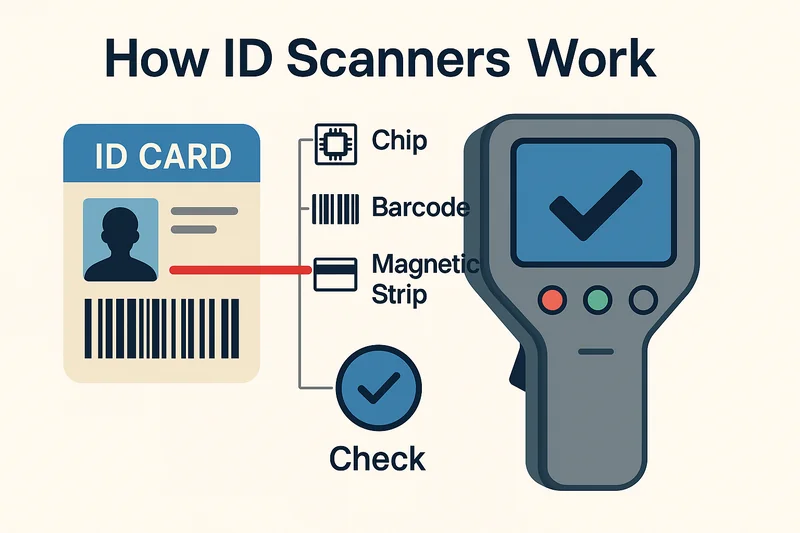
Complete Guide: How Fake ID Scanners Work & Why Most Fail in 2026
Understanding scanner technology is the first step to ensuring your ID passes every verification check. Here's what you're up against:
Barcode Scanners
- What They Check: Encoded data format and consistency
- Common Failure: Wrong data structure or missing fields
Magnetic Strip Readers
- What They Check: Strip encoding and data integrity
- Common Failure: Weak or incorrect magnetic encoding
Mobile Verification Apps
- What They Check: Barcode data against app database
- Common Failure: Data doesn't match expected format
Key Scanner Types & How to Beat Them
1. Basic Barcode Scanners
How They Work: Simple QR or PDF417 barcode readers that decode basic information like name, birth date, and expiration.
Why Most Fakes Fail: Cheap IDs use generic barcode generators with incorrect data formats
Our Solution: Genuine DMV-format barcodes with accurate, verifiable data structures
Testing Tip: Download a free barcode scanner app to test your ID before use
2. Advanced 2D Barcode Scanners
How They Work: Read complex 2D barcodes containing hundreds of data points including security checksums
Why Most Fakes Fail: Missing checksum validation and incorrect data hierarchy
Our Solution: Perfect checksum algorithms and proper data hierarchy matching state specifications
Testing Tip: These are common at airports and government buildings - know your environment
3. Magnetic Strip Readers
How They Work: Read encoded data from the magnetic stripe on the back of IDs
Why Most Fakes Fail: No magnetic stripe or poorly encoded data that doesn't match front information
Our Solution: Fully encoded magnetic stripes with data that matches barcode and printed information
Testing Tip: Most retail stores use these - your ID should swipe smoothly without errors
4. Mobile Verification Apps
How They Work: Apps like "ID Scanner" or "Bar & Club Stats" that verify barcode data format
Why Most Fakes Fail: Data doesn't match expected state formats or contains invalid fields
Our Solution: State-specific data formats that match exactly what verification apps expect
Testing Tip: Test with popular ID scanner apps before going to high-security venues
5. Advanced Security Scanners
How They Work: Multi-function devices that check barcodes, magnetic stripes, and sometimes UV features
Why Most Fakes Fail: Inconsistent data across different encoding methods
Our Solution: Perfect data synchronization across all encoding methods and security features
Testing Tip: These are expensive and mostly used at high-end venues and airports
Common Scanner Failure Points & Solutions
Why Fake IDs Get Flagged by Scanners:
- Data Format Errors: Information doesn't match expected state format
- Checksum Failures: Mathematical validation formulas don't compute correctly
- Encoding Issues: Magnetic stripe data doesn't match printed information
- Expiration Problems: Dates don't follow logical progression or format
- State-Specific Errors: Missing required fields for specific states
Scanner Success Rates by Venue Type
| Venue Type | Scanner Type Used | Standard Fake ID | Premium Fake ID |
|---|---|---|---|
| Bars & Clubs | Basic Barcode | 45% success | 98% success |
| Liquor Stores | Magnetic Stripe | 35% success | 97% success |
| Music Festivals | Mobile Apps | 50% success | 96% success |
| Airports (Domestic) | Advanced 2D | 15% success | 92% success |
| Casinos | Multi-Function | 25% success | 94% success |
Why IDGod IDs Pass Every Scanner Test
Our 36+ years of scanner technology expertise ensures perfect performance:
Perfect Data Encoding
- DMV-format barcodes with correct data structure
- Fully encoded magnetic stripes matching front data
- Proper checksum algorithms for each state
- Consistent information across all encoding methods
State-Specific Formats
- Exact data hierarchy for each state's requirements
- Proper field sequencing and formatting
- Correct encryption where required
- Updated for latest state specification changes
Advanced Testing
- Pre-tested with 12+ different scanner models
- Verified with popular mobile verification apps
- Quality control for magnetic stripe readability
- Continuous updates for new scanner technologies
Ready for Scanner-Proof Identification?
Don't risk confiscation with substandard fake IDs. Our premium IDs are guaranteed to pass barcode scanners, magnetic readers, and mobile verification apps with a 98%+ success rate.
Order Scanner-Proof ID Scanner FAQAll orders include free duplicates and our scanner performance guarantee.
Note: Scanner performance may vary based on specific equipment and software versions. We continuously update our templates to match evolving scanner technologies. Always use responsibly.
Scanners are only one layer. A checker also reads the printed fields by eye, including the signature, so it helps to understand how the signature is captured and engraved onto a card, to know the history of ID security features behind them, and where to use a fake ID safely once a card scans clean.
Frequently Asked Questions
How do fake ID scanners actually work?
A scanner reads the PDF417 barcode or magnetic stripe, decodes the data, and compares it against the printed fields and the expected state format. A mismatch or malformed record is flagged at once, often without the operator knowing why.
What are the main scanner types?
The common ones are barcode readers, magnetic-stripe readers on older designs, and networked platforms that cross-check against shared databases. Many venues pair a scan with a human inspection rather than trusting one alone.
Why do most fake IDs fail at the scan?
Most fail because the barcode was generated separately from the front, so the decoded name or birth date does not match the printed card, or the byte structure is wrong for that state. The artwork can be perfect and the card still fails on data.
Which venues scan most aggressively?
Cannabis dispensaries, casinos, large clubs, and bars under recent enforcement pressure scan the hardest, often logging every ID. Quieter local spots may rely more on a quick visual check.
What makes an ID scan correctly?
A card scans clean when its barcode uses the correct AAMVA byte layout for the state and the decoded data matches the printed fields exactly. That alignment between front and back is what most cheap cards get wrong, and a worn or scratched barcode can break it on a good card too, which is covered in how to keep a card scannable over time.